
Onboarding & Data Management
Onboarding
Every new organization follows the same onboarding flow to ensure clean data, consistent financial statements, and reliable analytics. This setup is mandatory and takes only a few minutes.
TL;DR
Upload a trial balance, design your statements, map your accounts. Ready in under 10 minutes.
1. Upload Data
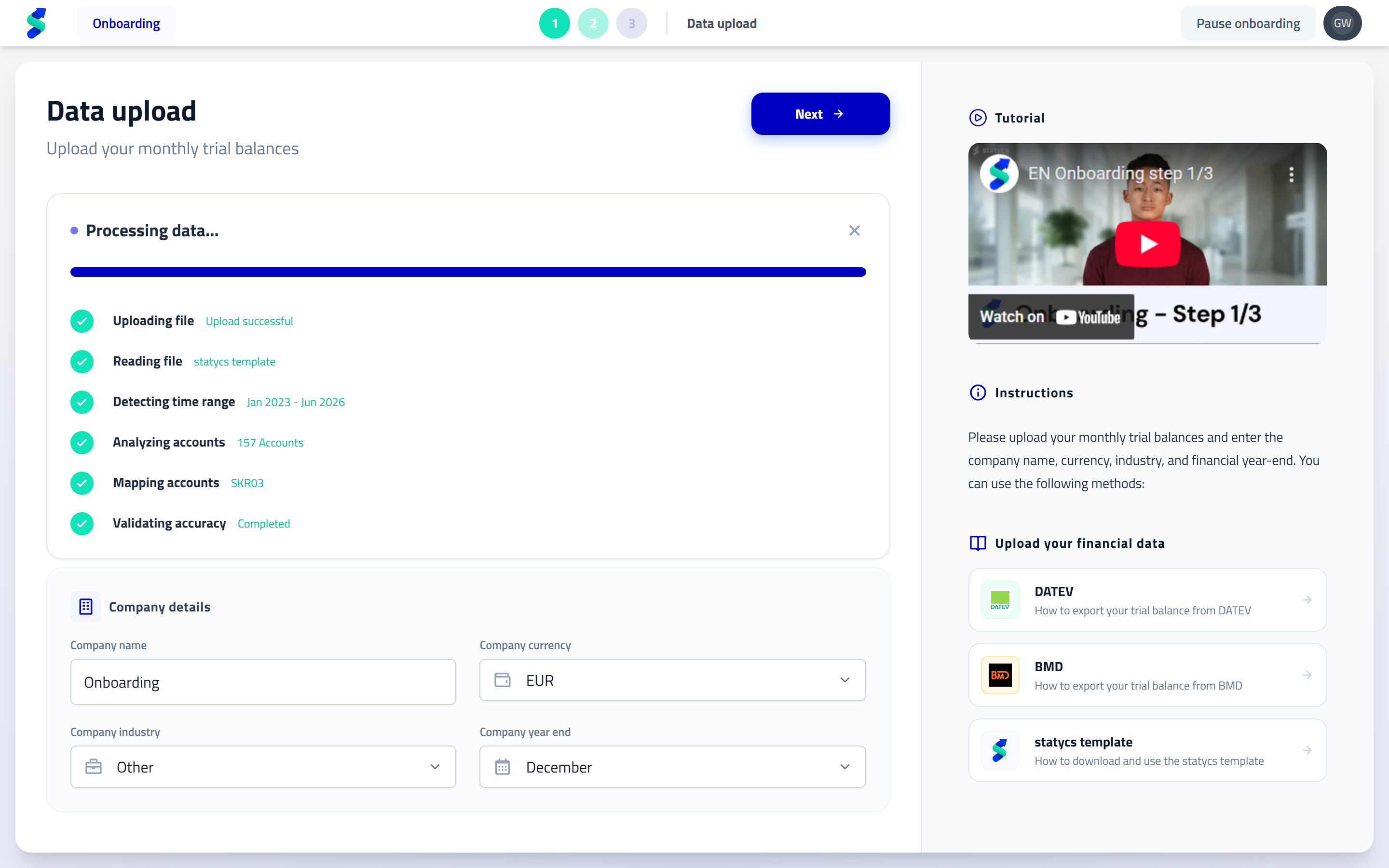
What you do
- Upload your trial balance using supported formats
- Define company name, fiscal year-end, industry, and currency
Why it matters
- Standardized imports prevent format and structure issues
- Clear guidance ensures correct exports and templates
Formats & inputs
- Additional input formats and integrations will be added continuously
- The onboarding flow remains the same for all future inputs
Validation
- Unsupported formats trigger an error with clear instructions
- You can only continue once a valid trial balance is detected
2. Design Financial Statements
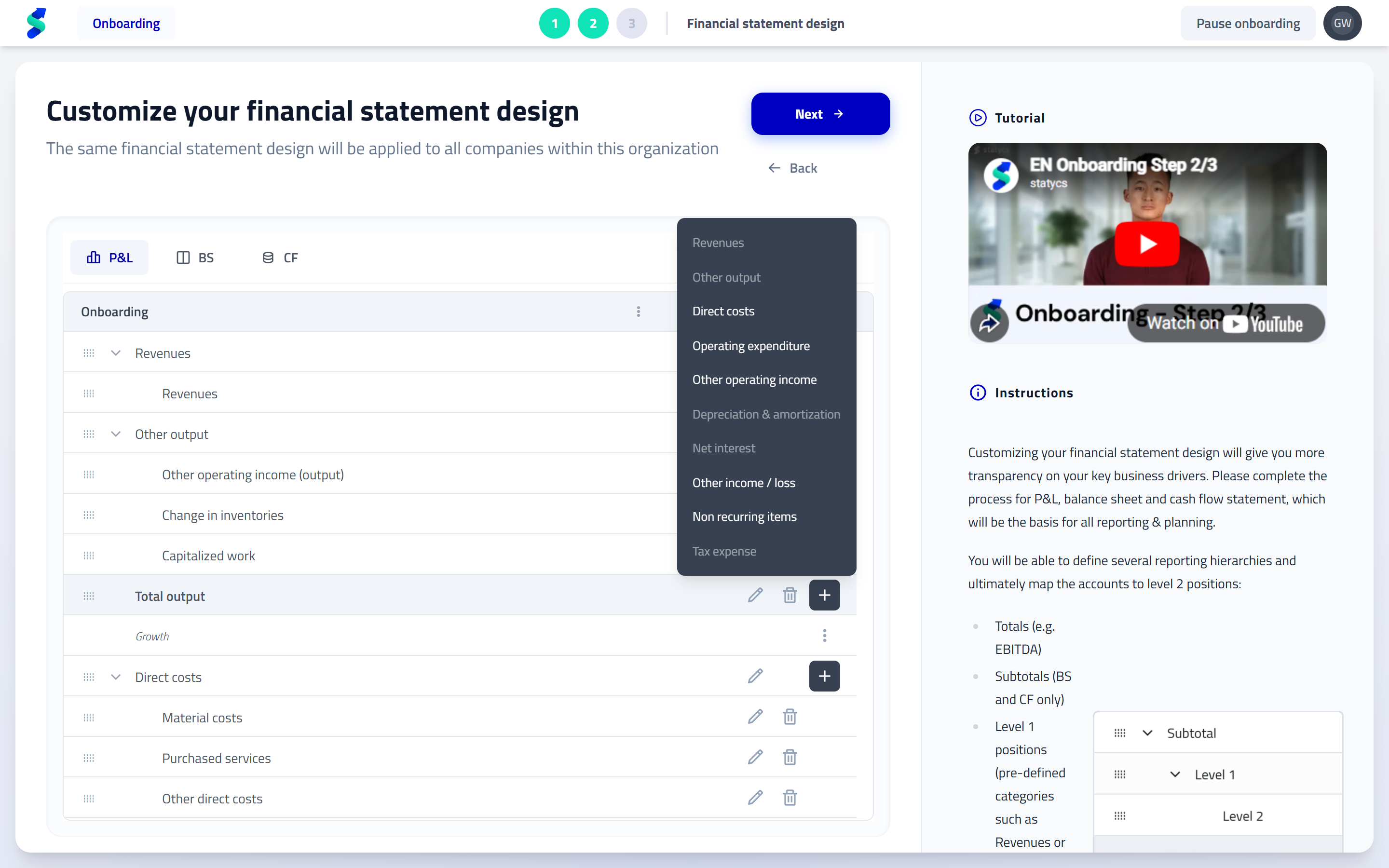
What you do
- Define the structure of your P&L, Balance Sheet, and Cash Flow
- Add and arrange Totals, Subtotals, Level 1, and Level 2 positions via drag & drop
- Start from templates or extend the predefined structure
Why it matters
- Reporting reflects your business logic—not your chart of accounts
- A consistent structure enables clean analysis and planning across all companies
You can refine Level 2 positions and account groups later. The goal at this stage is to establish a solid, consistent structure.
Predefined Level 1 positions
Level 1 positions are predefined to ensure standardized financial logic and reliable analytics. These positions cannot be removed.
P&L
- Revenues
- Other Output
- Direct Costs
- Operating Expenditure
- Other Operating Income
- Depreciation & Amortization
- Net Interest
- Other Income / Loss
- Non-recurring Items
- Tax Expense
Balance Sheet
- Fixed Assets
- Inventory
- Trade Receivables
- Other Assets
- Cash & Cash Equivalents
- Equity
- Provisions
- Financial Liabilities
- Trade Payables
- Advance Payments
- Other Liabilities
Level 2 positions and account groups are fully customizable within this structure.
Automatic logic & fixed positions
Certain positions include built-in logic to ensure consistent financial calculations.
- Level 2 positions under Fixed Assets automatically generate CapEx, depreciation, and cash flow entries
- Positions under EBITDA populate “Other Cash Flow” entries
Fixed (non-editable) positions
- EBITDA
- Net Income
- Total Assets
- Total Equity & Liabilities
- Cash & Cash Equivalents
- Retained Earnings / P&L Carryforward
- Non-categorized (placeholder for unmapped accounts)
3. Map Accounts
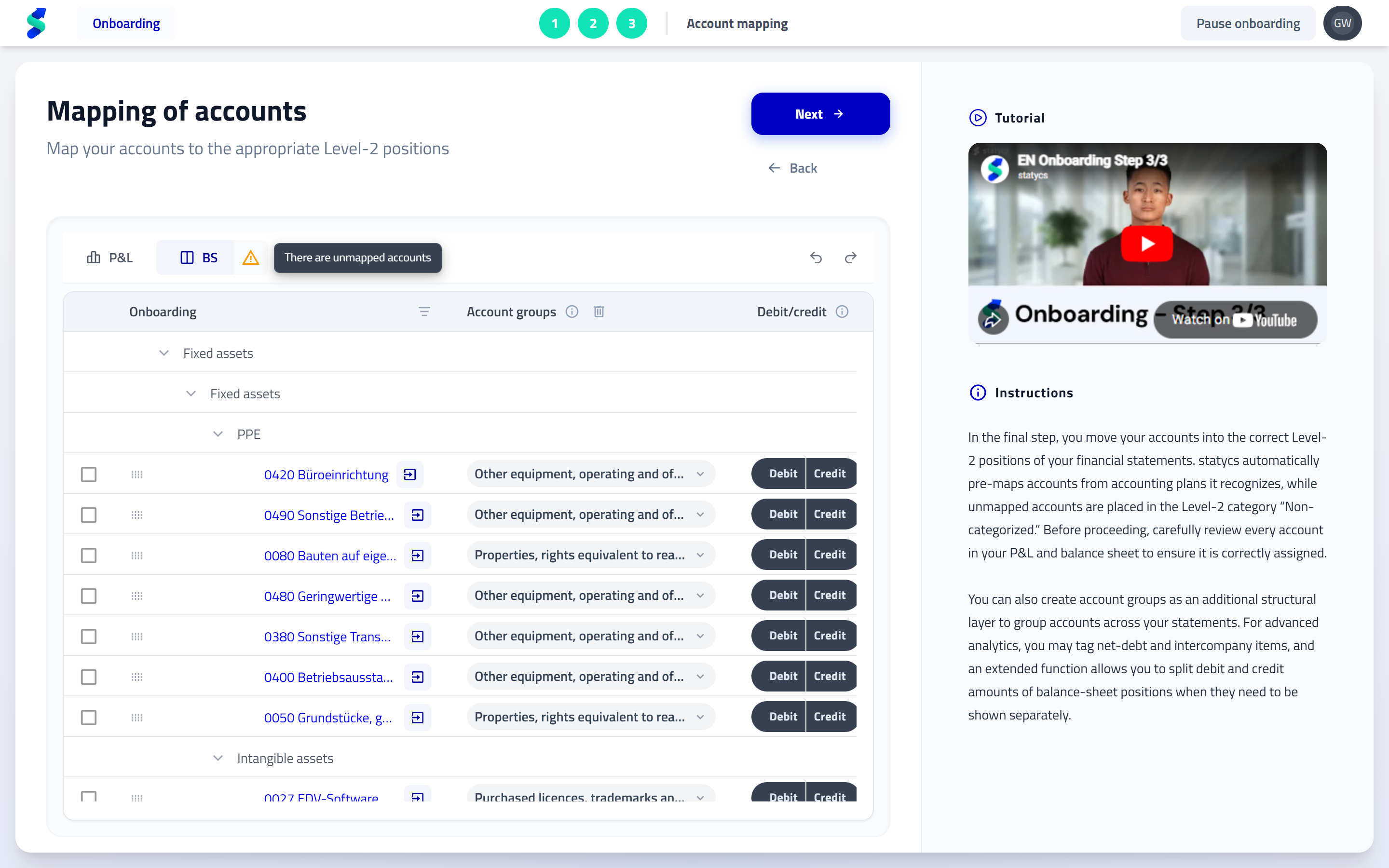
What you do
- Map trial balance accounts to Level 2 positions
- Create account groups as an intermediate structural layer between Level 2 positions and individual accounts
- Review and adjust auto-mapping (supported charts of accounts are recognized)
- Tag net debt and intercompany accounts
- Split debit and credit balances if required (e.g. negative receivables treated as liabilities)
Why it matters
- Automatic mapping reduces setup effort significantly
- Warning indicators immediately highlight unmapped accounts
- Correct structure and tagging prepare your data for analysis, planning, and consolidation
Account groups
Account groups are a structural layer between Level 2 positions and individual accounts.
They improve grouping, enable cleaner analysis, and serve as drivers in planning.
Account groups are reused consistently across Financials, Analysis, and Planning.
Automapping & new uploads
- Standard charts of accounts are mapped automatically
- For previously mapped companies, new uploads that contain new or unknown accounts place those accounts automatically into Non-categorized
- This allows you to immediately identify and map new accounts correctly without affecting existing mappings
- Automapping coverage will be expanded continuously
Data Management
The Data section is used to manage financial structures and company data after onboarding.
It separates shared financial structure from company-specific data to ensure consistency across entities.
It is split into:
- Organizational Data – shared financial statement design
- Company Data – uploads, mappings, and financial values per entity
Organizational Data
Changes made here affect all companies in the organization.
What you do
- Maintain the shared financial statement design
- Ensure consistent Totals, Subtotals, Level 1, and Level 2 positions across entities
Drafts, impact & publishing
- All changes are saved as drafts
- You can review the impact of design changes on financials before publishing
- Click Confirm to apply changes across the organization
Confirming a financial statement design is not reversible.
Translations
- Positions are stored in the language defined in user settings
- Default positions are translated automatically
- Custom positions not yet translated are marked with 🌍︎
- To translate custom positions, switch the language and adjust the financial statement design
Company Data
Company Data affects only the selected company.
It provides a centralized overview of all companies and their data status.
Company overview
For each company, you can see:
- Last sync – when financial data was last updated
- Uploaded time range – which periods are available
- Mapping status – whether unmapped accounts exist
⚠️ A warning indicator highlights companies with unmapped accounts.
From this overview, you can perform three core actions.
1. Upload Data
- Upload or sync trial balances at any time
- New uploads overwrite existing financial values
- The upload process is identical to onboarding
- Additional input formats and integrations will be added continuously
Review before confirm
- You will see the impact of overwritten data before confirming
Confirming an upload overwrite is not reversible.
2. Mapping
- Open Mapping to edit account mappings in draft mode
- Same functionality as during onboarding
- Accounts from new uploads are always placed under Non-categorized
- Users must explicitly review and map new accounts
- Use ⚠️ filters to locate unmapped accounts quickly
- Confirm or revert changes to publish them live
3. Delete Data
- Use Delete Data to remove financial values
from the last uploaded month onward - Designed for corrections and re-uploads
Review before confirm
- You will see the impact of deleted data before confirming
Deleting data is not reversible.
- Financial statement designs are never affected
- Account mappings are only removed if all company data is deleted
Why it matters
- Clear visibility into data health across all companies
- Full transparency before committing irreversible actions
- Full control over uploads, mappings, and financial values per entity